

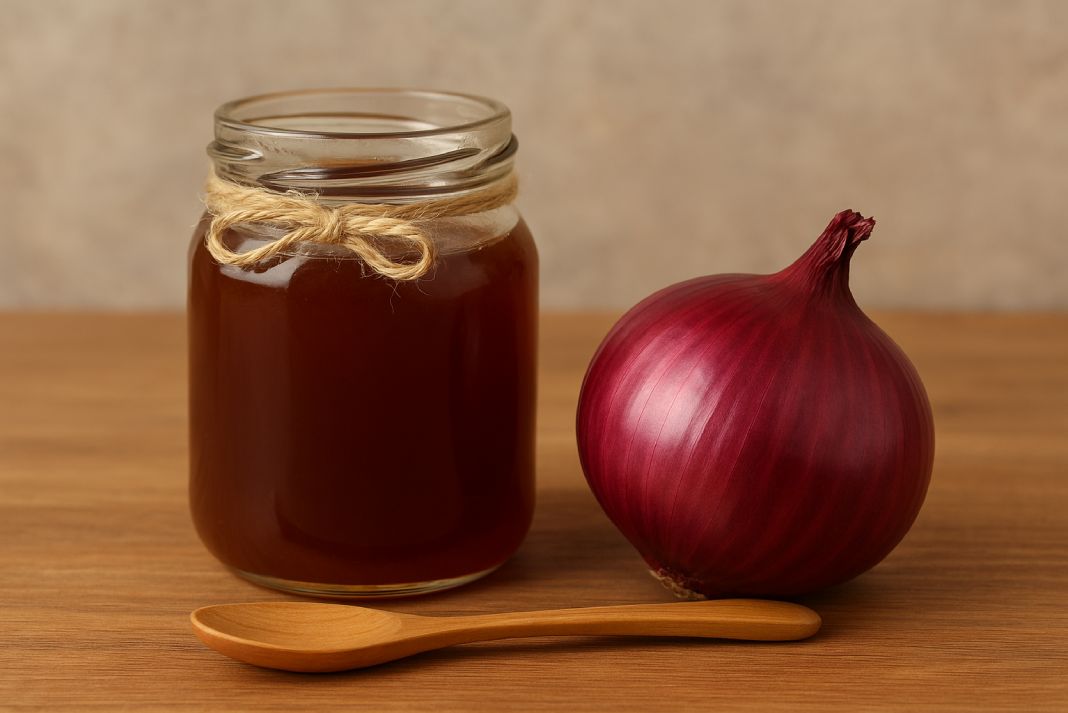
For centuries, households across the world—from rural India to Eastern Europe—have relied on a simple homemade syrup of onion and honey to ease coughs, sore throats, and colds. What was once dismissed as “grandma’s trick” is now backed by modern science.
Both onion (Allium cepa) and honey possess antimicrobial, anti-inflammatory, and soothing properties that can help reduce cough frequency, ease throat irritation, and even support immune defense. Unlike synthetic syrups filled with dyes and artificial flavors, this remedy is natural, affordable, and safe for most people when used correctly.
✅ According to the World Health Organization (WHO), honey is recognized as a safe and effective treatment for cough in children over 1 year old【source】.
✅ Onions contain quercetin and sulfur compounds with antiviral and antibacterial effects, which may inhibit respiratory infections【source】.
This guide explores 20 remedies and variations of onion & honey cough syrup—covering mechanism, preparation, dosage, risks, expert insights, and comparisons with modern treatments.
🧪 The Science Behind Onion & Honey
1. 🧅 Onion: Nature’s Antimicrobial
Mechanism: Onions contain quercetin, allicin, and sulfur compounds that reduce airway inflammation, thin mucus, and fight bacterial growth.
Research: Studies suggest onion extracts can reduce bronchial spasms and improve airway clearance【source】.
2. 🍯 Honey: Natural Cough Suppressant
Mechanism: Honey coats the throat, reducing irritation, while also delivering hydrogen peroxide, antioxidants, and antimicrobial peptides.
Research: A 2018 Cochrane Review found honey reduced cough frequency and improved sleep in children compared to placebo and diphenhydramine【source】.
Together, onion + honey act as a dual therapy: honey soothes irritation, while onion targets underlying infection and inflammation.
🍯🧅 20 Remedies & Variations of Onion & Honey Cough Syrup
Below are 20 science-backed remedies, each with mechanism, usage, and risks:
Remedy 1: Classic Onion & Honey Syrup
Mechanism: Combines onion’s quercetin + honey’s coating action.
How to Use:
Slice 1 onion.
Layer with raw honey in a jar.
Leave 6–8 hrs.
Strain liquid.
Take 1 tsp every 3–4 hrs.
Risks: Avoid in children under 1 year (risk of botulism).
Remedy 2: Onion Juice with Honey
Mechanism: Higher concentration of onion’s sulfur compounds.
How to Use:
Extract juice of 1 onion.
Mix with 2 tbsp honey.
Take 1 tsp, 2–3 times/day.
Risks: May cause stomach irritation in sensitive people.
Remedy 3: Warm Onion Tea with Honey
Mechanism: Heat extracts quercetin; honey soothes.
How to Use:
Boil onion slices in water 10 mins.
Strain, add honey.
Drink warm.
Risks: Strong odor; may cause reflux.
Remedy 4: Onion & Honey Steam Inhalation
Mechanism: Vapors loosen mucus; honey not heated but inhaled aroma soothes.
How to Use:
Add crushed onion + 1 tsp honey in hot water.
Inhale steam 10 mins.
Risks: Avoid in asthmatics (steam may trigger attacks).
Remedy 5: Onion, Honey & Ginger Mix
Mechanism: Ginger adds anti-inflammatory compounds (gingerol).
How to Use: Mix equal onion juice + honey + ginger juice. Take 1 tsp 2–3x/day.
Risks: May cause heartburn.
Remedy 6: Onion, Honey & Lemon Syrup
Mechanism: Vitamin C from lemon boosts immunity.
How to Use: Add 1 tbsp lemon juice to classic syrup.
Risks: Acidic; may irritate sensitive throats.
Remedy 7: Onion & Honey Lozenges (DIY)
Mechanism: Hard candy form prolongs throat coating.
How to Use: Boil honey until thick, mix onion juice, pour into molds.
Risks: Not for diabetics.
Remedy 8: Onion & Honey with Black Pepper
Mechanism: Piperine enhances absorption of quercetin.
How to Use: Add a pinch of pepper to syrup.
Risks: Spicy, may irritate children.
Remedy 9: Onion & Honey Fermented Syrup
Mechanism: Fermentation releases probiotics.
How to Use: Let onion + honey ferment 48 hrs, consume 1 tsp/day.
Risks: May fizz; unsuitable for small kids.
Remedy 10: Baked Onion with Honey
Mechanism: Heat caramelizes sugars, reduces sharpness.
How to Use: Bake onion halves, drizzle honey, consume.
Risks: Heat may reduce bioactive compounds.
Remedy 11: Onion, Honey & Garlic Mix
Mechanism: Garlic adds allicin → potent antibacterial.
How to Use: Mix equal garlic + onion juice + honey.
Risks: Strong odor; may thin blood.
Remedy 12: Onion, Honey & Turmeric Syrup
Mechanism: Curcumin is anti-inflammatory.
How to Use: Add ½ tsp turmeric powder to syrup.
Risks: Can stain teeth.
Remedy 13: Onion & Honey with Cloves
Mechanism: Clove oil is analgesic.
How to Use: Add crushed cloves to syrup, strain before use.
Risks: Not for children <2 yrs.
Remedy 14: Onion & Honey Cough Drops
Mechanism: Slow release of onion compounds + honey soothing.
How to Use: Evaporate syrup to thick stage, drop onto wax paper.
Risks: High sugar.
Remedy 15: Onion & Honey with Cinnamon
Mechanism: Cinnamon has antimicrobial cinnamaldehyde.
How to Use: Add ½ tsp cinnamon to syrup.
Risks: Cassia cinnamon high in coumarin (avoid excess).
Remedy 16: Onion & Honey with Thyme
Mechanism: Thyme relieves bronchial spasms.
How to Use: Steep thyme in syrup.
Risks: May interact with thyroid meds.
Remedy 17: Onion & Honey with Apple Cider Vinegar
Mechanism: ACV balances throat pH.
How to Use: Add 1 tsp ACV to syrup.
Risks: Acidic; dilute before use.
Remedy 18: Onion & Honey with Black Seed (Kalonji)
Mechanism: Thymoquinone fights inflammation.
How to Use: Mix ½ tsp black seed oil into syrup.
Risks: May lower BP.
Remedy 19: Onion & Honey Herbal Mix (Ayurvedic)
Mechanism: Combines tulsi, mulethi, onion, honey for cough.
How to Use: Boil herbs, add honey + onion syrup.
Risks: Avoid in pregnancy (mulethi).
Remedy 20: Onion & Honey Nighttime Soother
Mechanism: Added nutmeg promotes sleep.
How to Use: Add pinch of nutmeg powder to syrup before bed.
Risks: Excess nutmeg → hallucinations.
📊 Summary Table of Remedies
| Remedy | Added Ingredient | Mechanism Boost | Best For | Risk |
|---|---|---|---|---|
| Classic Syrup | None | Dual action | General cough | Honey unsafe <1 yr |
| Ginger Mix | Ginger | Anti-inflammatory | Phlegm cough | Heartburn |
| Lemon Syrup | Lemon | Vitamin C | Immunity | Acidic |
| Garlic Mix | Garlic | Antibacterial | Persistent cough | Odor, blood thinning |
| Cinnamon | Cinnamon | Antimicrobial | Winter cough | Coumarin risk |
| Night Soother | Nutmeg | Sedative | Night cough | Toxic in high doses |
🩺 Expert Quotes
“Honey has been shown to be superior to placebo and even some over-the-counter cough medicines in children.” – Dr. Paul IM, Penn State College of Medicine, JAMA Pediatrics, 2012【source】
“Onion’s bioflavonoid quercetin exhibits strong antiviral effects, particularly against respiratory viruses.” – Dr. Kim, Journal of Medicinal Food, 2016【source】
“Traditional onion–honey mixtures are safe, inexpensive, and may serve as complementary therapy in mild cough cases.” – World Health Organization Report on Traditional Medicine【source】
📅 Structured Routine for Usability
Morning: 1 tsp onion + honey syrup before breakfast.
Afternoon: Ginger + honey + onion mix if mucus heavy.
Evening: Lemon-enriched syrup for immune boost.
Night: Nutmeg or cinnamon variation for soothing sleep.
Duration: Use up to 7 days; consult a doctor if cough persists beyond this.
❓ FAQ Section
Q1. How long does onion & honey syrup take to work?
➡ Relief often starts within 24–48 hours.
Q2. Can children take it?
➡ Safe only for children over 1 year old (risk of botulism under 1).
Q3. Is it better than OTC syrups?
➡ Studies suggest honey is as effective—or better—than dextromethorphan for mild coughs.
Q4. Can diabetics use this syrup?
➡ With caution—honey raises blood sugar. Opt for smaller doses.
Q5. How long can the syrup be stored?
➡ Refrigerated: up to 1 week. Fermented versions: up to 1 month.
Q6. Are there side effects?
➡ Possible stomach upset, heartburn, or allergy in sensitive people.
Q7. Can it be used for dry & wet cough?
➡ Yes—works for both by soothing irritation and loosening mucus.
Q8. Can I use red onion or white onion?
➡ Both work, but red onion has higher quercetin content.
⚠️ Disclaimer
This guide is for educational purposes only. While onion and honey are natural remedies with scientific support, they are not substitutes for medical treatment. Consult a physician if:
Cough lasts longer than 7 days.
There is fever, chest pain, or breathing difficulty.
The patient is a child under 1 year.